When we talk about LNG (Liquefied Natural Gas), people often focus on liquefaction technology, storage tanks, or transportation vessels.
However, behind these large-scale facilities, thousands of meters of piping systems play a critical role in connecting different processing units and ensuring stable operation
From transporting natural gas before processing to circulating refrigerants during liquefaction, piping systems are one of the fundamental components of an LNG plant.
The reliability of these pipes directly affects the safety, efficiency, and long-term operation of the entire facility.
Natural gas cannot be transported efficiently over long distances in its gaseous state. LNG technology solves this challenge by cooling natural gas to
approximately -162°C, reducing its volume significantly and allowing it to be transported by LNG carriers.
A typical LNG facility includes several key sections:
1. Natural Gas Treatment
Before liquefaction, raw natural gas contains impurities such as water, carbon dioxide, and other components that need to be removed.
During this stage, piping systems transport natural gas and treatment fluids between different processing units. Materials must be selected carefully
to ensure corrosion resistance and reliable performance.
2. Liquefaction Process
The liquefaction section is the core of an LNG plant.
Through advanced refrigeration cycles, natural gas is gradually cooled until it becomes liquid LNG. This process requires complex equipment,
including compressors, heat exchangers, and extensive piping networks.Because these systems operate under demanding conditions, piping
materials need to provide:
Excellent corrosion resistance
Stable mechanical properties
Long service life
Reliable performance under low-temperature conditions
3. LNG Storage and Export
After liquefaction, LNG is transferred to storage tanks and then transported to customers worldwide.
Reliable piping systems continue to play an important role in maintaining safe transfer operations.
Different areas of an LNG plant require different materials depending on operating conditions. Stainless steel is widely selected for many
process piping applications because of several advantages.
Corrosion Resistance
LNG plants involve various process fluids and operating environments. Stainless steel provides excellent resistance to corrosion,
helping maintain piping integrity during long-term operation.
Strength and Durability
Process piping must withstand continuous operation, pressure changes, and complex working conditions.
Stainless steel offers stable mechanical performance and reliability.
Clean Surface and Process Requirements
For certain process systems, smooth internal surfaces and good cleanliness are important.
Stainless steel pipes can meet these requirements through controlled manufacturing and surface treatment processes.
Large LNG plants are often designed with multiple production units, known as trains.
A train represents an independent LNG production line, including major equipment and supporting systems. By adding more trains, LNG facilities can increase production capacity.
In modern LNG projects, many major systems are built in a modular approach. These integrated units are commonly referred to as Block Trains,
where equipment and piping systems are assembled as complete production blocks before installation at the project site.
This approach helps improve construction efficiency, quality control, and project schedule management.
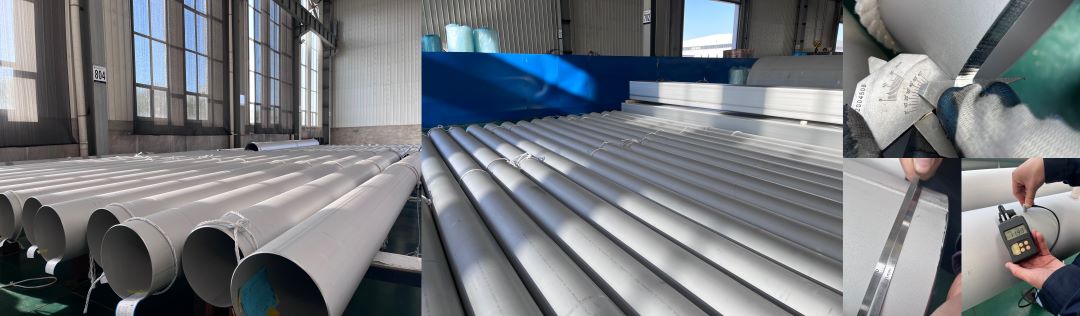
In one LNG project in Italy, our stainless steel welded pipes were installed inside LNG Block Train units as part of the natural gas liquefaction process piping system.
Project Highlights:
Material: ASTM A312 TP304/304L & ASTM A358 TP304/304L CL.1
Size Range: NPS 8"–42"
Wall Thickness: SCH10S–80S
Quantity: 112,664 kg
Delivery Time: 70 days
The supplied pipes successfully passed the customer's appointed third-party inspection and were delivered according to the project schedule.
LNG projects require reliable equipment and piping systems to ensure safe and efficient operation.
While major equipment such as compressors and heat exchangers often receive the most attention, piping systems remain an essential part of the entire LNG value chain.
With experience in stainless steel welded pipe manufacturing, we continue to support energy projects by providing reliable piping solutions for demanding industrial applications.
Navigation
Tel.: +86 512 6586 3562
Phone: +86 152 5043 1153
Fax: +86 512 6586 3052
E-mail: sales@sincoometal.com
Address: Room 508, Building 23, Times Square, Suzhou Industrial Park, (Jiangsu) Pilot Free Trade Zone, China 215000